
Why Use 3rd Party Support for Retail Strategic Planning
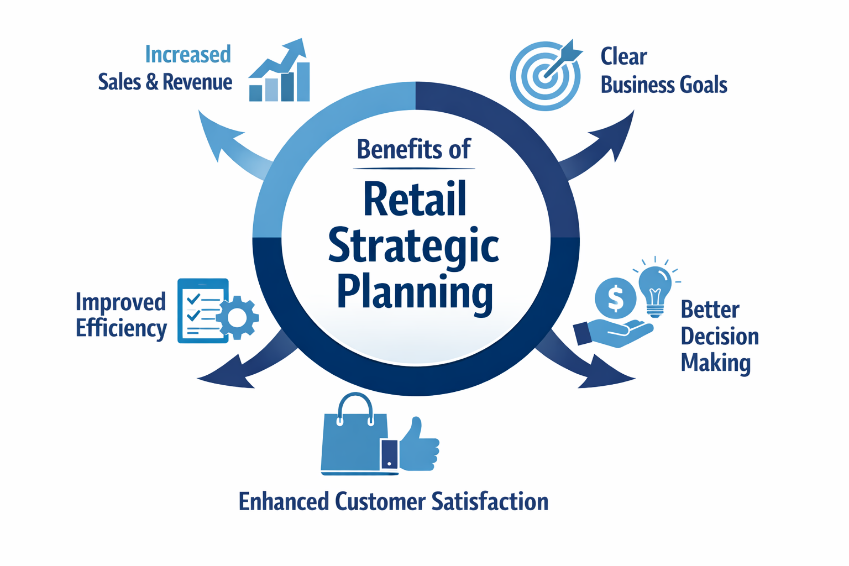
The old adage, “Retail is detail” has never been truer. Never have retailers, vendors, and consultants had more data to leverage in understanding the customers, the products, inventory, and supply chain. Of course, the added data and systems have created a level of complexity never experienced before. As a result, strategic planning becomes both easier and more difficult. It’s easier because there is more accurate, detailed information available. And it’s difficult because the ability to analyze and plan around the volume of information is difficult and consistently evolving. It requires a new adaptability and skill set not needed before. This is where leveraging 3rd party expertise helps.
Margin pressure, labor challenges, omnichannel competition, and evolving regulatory standards demand more than instinct-based decision-making. To compete and scale successfully, retailers and their vendors increasingly rely on retail strategy consulting. Consulting that includes strategic growth and both management and compliance consulting. Together, these disciplines provide the structure and insight needed to drive sustainable performance.
What Role Does Data Analysis Play in Retail Strategy Consulting?
Data analysis is the backbone of effective retail strategy consulting. Without quantitative insight, strategy becomes speculative. With robust data analysis, it becomes predictive and actionable.
Retail strategy consultants analyze:
Sales trends by category and SKU
Gross margin performance
Inventory turnover and working capital
Customer acquisition and retention metrics
Conversion rates and basket size
Trade area demographics
Competitive pricing benchmarks
Advanced analytics tools help identify patterns that may not be visible through high-level reporting. For example, data may reveal that a small percentage of SKUs drive a disproportionate share of margin, or that specific customer cohorts deliver significantly higher value.
Data analysis also supports scenario modeling. Consultants can predict the financial impact of price adjustments, assortment changes, labor restructuring, or store expansion. This allows leadership teams to make informed decisions with a quantified risk.
In short, data analysis transforms retail strategy consulting from conceptual planning into disciplined growth engineering.
How Can Retail Strategic Growth Strategies Boost Sales and Customer Retention?
Retail strategic growth is most effective when it balances revenue generation with customer loyalty. Growth strategies that focus solely on new customer acquisition often overlook long-term profitability.
Effective retail strategic growth initiatives boost sales and retention by focusing on:
1. Customer-Centric Assortments
Curating products based on customer purchasing behavior increases conversion rates and average transaction value.
2. Pricing & Promotion Optimization
Data-driven pricing strategies improve margin while maintaining competitive positioning. Personalized promotions strengthen loyalty.
3. Omnichannel Integration
Seamless transitions between online and in-store experiences increase convenience and reduce friction, leading to higher retention rates.
4. Loyalty Programs & CRM Strategy
Structured loyalty initiatives improve repeat purchase frequency and deepen customer engagement.
5. Store Experience Enhancement
Improved layout design, better merchandising standards, and trained associates elevate in-store experiences.
Retail strategic growth strategies are most powerful when they connect operational improvements with customer insight. Increased sales become sustainable when customers feel understood and consistently served.
When Should a Business Consider Hiring a Retail Growth Consulting Firm?
Retailers and their vendors often wait too long to seek external expertise. However, certain indicators suggest that engaging a retail growth consulting firm can accelerate results and reduce risk.
A business should consider retail growth consulting when:
Revenue growth has plateaued or declined
Margins are compressing despite stable sales
Inventory levels are increasing without corresponding sales gains
Store expansion is being considered
Multi-store complexity is becoming difficult to manage
Leadership lacks clear performance visibility
Capital allocation decisions feel reactive rather than strategic
Retail growth consulting provides objective perspective. Internal teams may be too close to operations to identify structural inefficiencies or missed opportunities. Consultants bring analytical rigor, benchmarking insights, and structured frameworks to guide expansion, repositioning, or operational transformation.
Engaging early—before financial distress becomes severe—allows retailers and vendors to act proactively rather than defensively.
What Challenges Do Retail and Vendor Management Consultants Typically Solve for?
Retail management consulting addresses operational barriers that prevent strategy from translating into performance. Even the strongest growth plan can fail if execution is inconsistent.
Common challenges solved by retail consultants include:
Operational Inefficiencies
Ineffective replenishment processes, excess inventory, store standards that are hard to understand, and poor item and POG level management can erode profitability.
Supply Chain Constraints
Long lead times, vendor concentration risk, and forecasting inaccuracies create stock imbalances and working capital strain.
Performance Visibility Gaps
Retailers often lack unified KPI dashboards from their vendors, making it difficult to track performance across stores, channels, and customer groups.
Change Implementation Barriers
Resistance to and help with new processes or systems can stall improvement initiatives.
Retail consultants can introduce structured tools for vendors such as process mapping, lean methodology, KPI dashboards, benchmarking analysis, and organizational redesign frameworks. They also ensure the vendors understand and can support new retailer systems and growth objectives.
The Integrated Retail Advantage
Retail strategy consulting sets the direction. Retail strategic growth defines the roadmap. Retail growth consulting accelerates expansion. Finally, Retail management consulting ensures effective execution.
Together, these disciplines create a comprehensive framework for sustainable performance. In an industry defined by volatility and tight margins, retailers and vendors that leverage structured consulting expertise position themselves for stronger sales, improved retention, operational efficiency, and long-term resilience.
Growth in retail is rarely accidental. It’s built on strategy, supported by data, and executed with excellence.