
What Is Retail Strategy Consulting and How Can It Help Businesses Grow?
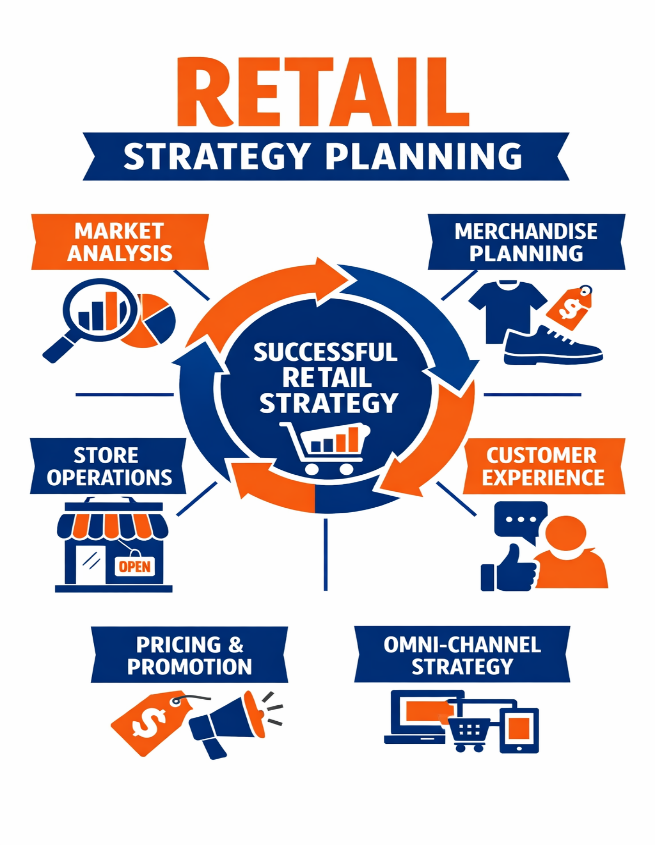
Retail strategy consulting focuses on defining where a retail vendor should compete, and how it will win. It involves evaluating market positioning, competitive dynamics, customer segmentation, pricing architecture, merchandising strategy, and channel mix.
At its core, retail strategy consulting answers foundational questions:
Which categories and channels should we prioritize?
How do we allocate capital for the highest return?
What is the best pricing strategy
What are the most effective ways to merchandise the product in store and online
A well-developed retail strategy aligns brand, product, operations, and financial objectives. It eliminates fragmented decision-making and ensures that growth initiatives reinforce one another rather than compete for resources.
For example, a specialty retailer struggling with margin erosion may discover through strategic analysis that assortment complexity is driving inventory inefficiencies. By rationalizing SKUs and focusing on high-velocity, high-margin categories, the retailer can improve both sales productivity and gross margin.
Ultimately, retail strategy consulting helps businesses grow by creating clarity, focus, and disciplined execution around the right opportunities.
How Does Retail Strategic Growth Planning Improve Store Performance?
Retail strategic growth planning translates high-level strategy into actionable initiatives. It identifies where incremental revenue and profit can be captured and builds a roadmap to achieve it.
This planning typically includes:
Store productivity improvement initiatives
Assortment optimization
Pricing and promotion refinement
Omnichannel integration
Customer retention strategies
When done correctly, retail strategic growth planning improves store performance by concentrating resources on high-impact drivers. Instead of broadly increasing marketing spend or expanding inventory indiscriminately, retailers deploy targeted initiatives that drive measurable results.
For brick-and-mortar stores, this may mean reconfiguring floor layouts to improve traffic flow and conversion. For omnichannel retailers, it may involve integrating digital and physical inventory to reduce stockouts and increase fulfillment efficiency.
Growth planning also establishes clear performance metrics—sales per square foot, inventory turns, conversion rate, basket size—so leadership can monitor progress and adjust tactics quickly.
The outcome is not just growth, but profitable growth grounded in operational realities.
What Are the Benefits of Retail Growth Consulting for Large Retailers and Their Vendors
Retail growth consulting delivers benefits across company sizes, but the value often differs by scale.
For Small and Emerging Retailers
Smaller retailers often lack dedicated strategic resources. Retail growth consulting provides:
Objective outside perspective
Structured financial modeling
Data-driven expansion plans
Scalable operational frameworks
Consultants help smaller retailers avoid common pitfalls such as overexpansion, margin compression, or misaligned inventory investments. By building disciplined growth plans early, these businesses can scale sustainably.
For Large and Enterprise Retailers
Larger retailers face complexity rather than resource constraints. Retail growth consulting supports:
Portfolio rationalization
Multi-brand optimization
Category profitability analysis
M&A integration planning
Channel conflict resolution
Enterprise retailers often operate across regions, formats, and digital platforms. Growth consultants bring analytical rigor to identify underperforming assets, unlock working capital, and prioritize high-return investments.
In both cases, retail growth consulting accelerates decision-making, improves capital allocation, and reduces execution risk.
How Can Retail Management Consulting Optimize Operations and Increase Efficiency?
Retail management consulting focuses on the operational engine of the business. While strategy defines direction, management consulting ensures the organization can execute efficiently and consistently.
Key areas of optimization include:
Supply chain efficiency
Inventory management
Labor productivity
Store processes and standards
Organizational design
Performance management systems
Operational inefficiencies can quietly erode profitability. Excess inventory ties up working capital. Poor labor scheduling reduces productivity. Inefficient replenishment processes create stock imbalances.
Retail management consulting introduces standardized processes, performance dashboards, and accountability structures. It often includes benchmarking against industry best practices and implementing lean principles to eliminate waste.
For example, optimizing inventory forecasting and replenishment can increase inventory turns while reducing markdowns. Refining labor scheduling models can improve customer service while lowering overtime expenses.
The result is a more agile organization that delivers consistent performance across stores and channels.
What Does Retail Compliance Consulting Involve and Why Is It Important for Stores?
Retail compliance consulting ensures that stores operate within regulatory, contractual, and internal governance requirements. As retail environments become more complex, compliance risk increases.
Retail compliance consulting typically covers:
Labor law adherence
Wage and hour regulations
Safety standards
Vendor contract compliance
Data privacy requirements
Environmental and product regulations
Internal audit processes
Non-compliance can result in fines, lawsuits, reputational damage, and operational disruption. In highly regulated categories such as food, pharmaceuticals, or consumer electronics, compliance failures can be particularly costly.
Compliance consulting establishes policies, documentation standards, audit protocols, and training programs that reduce risk exposure. It also creates monitoring systems to ensure ongoing adherence rather than one-time fixes.
Importantly, compliance is not just about avoiding penalties—it supports operational consistency and brand integrity. Customers trust retailers that demonstrate transparency, fairness, and responsibility.
Bringing It All Together
Retail strategy consulting sets the direction. Retail strategic growth planning builds the roadmap. Retail growth consulting accelerates expansion. Retail management consulting optimizes execution. Retail compliance consulting protects the business.
When integrated, these disciplines create a powerful framework for sustainable retail success. In an environment where margins are tight and competition is intense, disciplined strategy and operational excellence are no longer optional—they are essential.
Retailers that invest in structured consulting support gain clarity, improve performance, reduce risk, and position themselves for durable, profitable growth.