
Tariffs and Their Impact on Retail
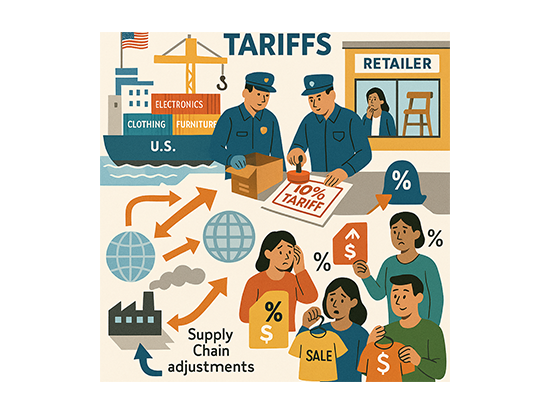
The Tariff Program of the last couple of years has arguably impacted U.S. Retail more than any other sector of the U.S. economy. And it appears the unpredictability and confusion regarding tariffs may persist in 2026. Indeed, Tariffs have become a very significant factor influencing retail analysis and decision making across most functions such as: pricing, vendor and product selection, and supply chain. How did this situation develop and what is forecasted going forward?
In 2025, the U.S. government implemented a series of tariff increases on various imported goods, particularly from China and some other key trading partners. This was part of an ongoing effort to address trade imbalances and promote domestic manufacturing. However, the tariffs have had mixed outcomes, with many retailers facing increased costs that they either need to absorb or pass on to consumers.
2025-2026 Tariff Timeline
January 2025: The U.S. announced a 10% tariff on a broad range of consumer goods, including electronics, clothing, furniture, and a range of building materials.
March 2025: Additional tariffs on specific goods such as toys and sports equipment were introduced, leading to a substantial backlash from retailers.
June 2025: The administration proposed negotiations with trade partners to reassess and potentially reduce tariffs, but progress was slow.
September 2025: Retailers reported a significant drop in consumer spending, attributed to rising prices caused by tariffs.
November 2025: Some companies reported falling stock prices despite positive earnings reports highlighting the impact of tariffs on investor confidence.
February 2026: The U.S. Supreme Court ruled that tariffs imposed under emergency powers (IEEPA) were illegal, and the administration replaced them with a new 10% tariff structure. This amounts to a temporary 10%-15% global tariff on imports into the United States. The major
Impact on U.S. Retail Overall
The influence of tariffs on the retail sector has been profound, manifesting in several ways:
1. Increased Costs
Retailers have faced rising costs due to tariffs on imported goods. In many cases, retailers chose to absorb some of these costs rather than pass them entirely onto consumers, which has squeezed their margins.
2. Consumer Sensitivity
As prices rise, consumers have become more price sensitive. Reports indicate a noticeable shift toward budget-friendly brands and products, resulting in a decline in sales for higher-end retailers. The overall consumer sentiment is cautious, with many shoppers opting to delay purchases or seek discounts.
3. Supply Chain Adjustments
Retailers are adjusting their supply chains to mitigate the impact of tariffs. This includes sourcing products from countries not affected by tariffs or investing in domestic manufacturing capabilities. For example, some companies are turning to automation and artificial intelligence to streamline operations and reduce costs.
4. Strategic Pricing
To cope with increased costs, retailers are implementing strategic pricing adjustments. This involves not only raising prices but also offering smaller product sizes or bundles to maintain sales volumes without scaring off consumers with higher prices.
Most Impacted Categories
For industries like home improvement, building materials, and flooring, tariffs matter because many inputs are imported. And the impact on pricing has been notable. The retailers and consumers are seeing:
Higher input costs
Vinyl flooring, tile, tools, and hardware components often come from Asia.
Price pressure at retail
Retailers like:
Home Depot
Lowe's
Floor & Decor
The price pressure may push vendors for cost absorption or private-label shifts.
Retailer Strategies in Response to Tariffs
Considering the many challenges, retailers are employing various strategies to adapt to the evolving landscape:
Cost Absorption: Some companies are opting to absorb a portion of the tariff costs to keep prices stable and to retain their customer base.
Product Innovation: Retailers are focusing on creating unique product offerings that can justify higher price points, thus mitigating the impact of tariffs.
Local Sourcing: Many retailers are exploring local sourcing options to avoid tariffs altogether. This not only helps cost management but appeals to consumers' growing preference for locally made products.
Negotiation with Suppliers: Retailers are negotiating with suppliers for better terms, seeking to share the burden of tariff-induced cost increases.
As the U.S. continues to grapple with the ramifications of tariff policies, the retail industry is at a crossroads. The strategies adopted now will likely shape the future of retail as companies adjust to a landscape increasingly defined by trade policies. While the immediate outlook may seem challenging, the ability of retailers to innovate and adapt will ultimately determine their resilience in the face of these economic pressures. And as these challenges
unfold, Paradgym Consulting will stay informed and involved and offer insights to our clients on how to mitigate against them.